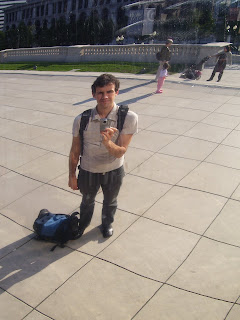
A terrible thing happened on Saturday morning, which I just learned about yesterday. Mkhululi, one of the guys from Siyaya was hit by a combie (mini-bus taxi) and is in the ICU. He is one of the three guys I went to Mzoli's with last weekend.
I went in to visit him in the hospital today with Bonganyi, the music director, and Johanna. The kid is in very bad shape. I was glad for my experience working in the ICU at the hospital last summer, which prepared me for this a little bit. But I was not working in a trauma ICU, and nearly all of the patients were older people in more advanced stages of disease. Some were hooked up to machines and respirators, just like Mkhululi was. But it is much different to see a healthy young person, especially one you have hung out with in that situation. He had thick bandages on his head, which was very swollen, and the machines were doing all the work for him, violently pounding breaths in and out of his heaving chest, as he is probably in an induced coma. He is only twenty-two, and he is a father. I was glad other members of Siyaya were not there with us.
There is not much you can say in such a situation. There were no family or friends to comfort, and Mkhuli was unconscious, but just seeing someone you know like that is not easy. You ask yourself, why does God allow this? That was always one of the hardest things to address as a hospital chaplain. I didn't have anything profound to say. The only God I could speak about in the hospital was one who is present in human suffering, and does not sit far off and aloof, too pure to get the divine hands dirty. If God doesn't get down in the mess with us, then there is not much use in talking about God. That at least was my feeling. So what is it like when God gets down in the muck with us? That was my question, and I had no answers. Often it was the patients and family members themselves who would be doing the ministry to me in that situation. They had much more business telling me about faith, I thought, than me trying to tell them.
What do I know? I can make the proclamation, "God is here in this tragic moment", but I couldn't point God out. When you sit beside a woman moaning in agony from bone cancer (which has to be about the worst ailment imaginable) theoretical theology is meaningless. She doesn't care, for instance, that Alvin Plantinga has proved that there is no logical inconsistency between belief in a perfectly good God and the reality of human suffering. These abstractions don't matter when you are living in the pain. There is nothing to say, as a pastor, in that situation. Ministry of presence is important -- sometimes it's all you have -- but much of the time it just isn't enough. Hospital visits militate against pat answers and easy solutions. Somehow, that is why I am drawn to situations like that. I don't like easy church answers. I would rather be real about the complexity, the incomprehensibility of suffering. It won't just go away by ignoring it.
A glum posting, I know. But this is life everywhere.
Monday, July 2, 2007
Sunday, July 1, 2007
Township tours with Xolani

Now that the internet is working again, I wanted to post some pictures I took a week ago when I went on Xolani May's township tour. Xolani does these for a living, and often has groups of visitors from out of the country whom he will take along on a half or full day tour of Guguletu, Philipi, and other neighboring townships. There are several companies and individuals who do these tours (a number are listed in my guidebook) although not all of them are township residents like Xolani is. You would never guess to look at him, but Xolani lives in an informal settlement, or just a shack as he is not embarrased to call it. I am giving him huge props for these tours, and it would be great if he could advertise commercially, since much of his business currently comes through connections to JL Zwane.
 I really think a township tour like this is the most worthwhile thing someone can do in South Africa. There are lots of sights to see and things to do, but I feel that meeting the people in the country is the most important thing one can do while travelling. Seeing how people in a country live and interacting with them takes one past the simple tourist sight-seeing to actually engage (at least a little bit) with people. Because that's what a place is really about: people. This is particularly true in a country like South Africa which such a history of injustice, inequality, violence, and oppressive poverty. Most people from Europe and the States who come here probably go to Cape Town or one of the other big cities and enjoy the First World amenities and activities, see some wildlife at Kruger, tour the winelands, surf if that's your thing, and go home. All of these things are extremely worthwhile, but they are also an excellent recipe for not having a substantive interaction with non-white people. Now there is not really much to see in the townships for a tourist. You go there for the people, and to see the contrast with neighborhood where your hotel probably is. The fact that the township is not a tourist destination is acatually the best reason to go there, as tourist areas never tell the whole story about a culture. So in my opinion, on a visit to South Africa a township tour is a must.
People who live in Guguletu are proud of it. In fact the name means "our pride". Like other Cape Flats townships, Guguletu was founded in the 1950s when blacks were forcibly removed from Cape Town proper, and other "seasonal labourers" from Eastern Cape also needed housing. Initially, cookie cutter houses were built to house the men who left there families at home to work here and send money back. This was too expensive so eventually the government and the major companies employing these labourers (Coca-Cola, for instance) started building single-sex dormatory-style "hostels", which are still in use today, often with as many as ten people living in a space the size of my dorm room. The amenities in some of the company hostels are much better than in the government ones, although they still tend to be crowded. These housing options were made to be more or less affordable on the extremely low wages the labourers earned. Other, better homes were also built, but these were equalled in number by the shanties that sprang up later on.
There was only one road in and out of Guguletu in those early years, NY1, which is still the heart of the township. All the streets around here are just numbered "Native Yards", although they have been given proper names since 1994 (which pretty much no one uses, and they aren't labelled anyway). The way in and out of Guguletu was controlled by police, who restricted everyone moving in and out according to their government issued pass. I will write in greater detail about the pass laws later, but essentially they classified each non-white person as either a "native" or "coloured", and police could stop you indiscriminately, and at random whenever they wanted and demand your pass. These laws kept non-whites confined to certain areas, whether townships or the Bantustans (which were instituted around the same time), and millions were locked up for pass "violations" over the nearly fifty years of Apartheid. Massive resistance to the pass laws and demonstrations led to the Sharpeville Massacre in 1960 ( http://en.wikipedia.org/wiki/Sharpeville_Massacre ).
Locally, on 3 March, 1986 government anti-terrorist units (members of the dreaded Vlakplaas) stopped a mini-bus full of students affiliated with the ANC (African National Congress, now the ruling party) and brutally shot seven of them dead. Television and radio stories that day proclaimed that government units had killed seven "terrorists", and as the Truth and Reconciliation Commission later revealed, weapons were planted on the dead bodies. Governments since the Roman Empire have been using that label for underground resistance fighters. We should be thoughtful about how that term is used by media and by government, and how we are intended to regard people so labelled differently. Those labeled "latrones" by the Romans became eligible for the extreme punisment of crucifixion, and it is often argued today that extreme tactics are necessary to combat terrorists. Back to the Guguletu Seven, pictures at a local mini-museum show smiling soldiers standing over bullet-riddled bodies while neighbours look on from behind the police barricades. There is a memorial there today, part of which is pictured here.
Other highlights included a visit to a Shebeen, an informal tavern in an informal settlement building, which were once illegal, but are sort of okay now. Actually, when we walked in all the men in place became suddenly very quiet. It was not until Xolani explained to them that the white man was not an undercover detective that they lightened up and I got a round of what they were drinking. In this picture I am drinking umqombothi ( http://www.dispatch.co.za/1999/07/31/features/ROMANS1.HTM ), a home-made beer-like concoction made from sorghum and mealie (corn). It looks like soapy water and was a bit thicker than beer. And grainy. It has a sweetish, perfumey taste, and the texture of very thin Cream-of-Wheat. An acquired taste I think, although I hear Anheuser-Busch is marketing a sorghum beer in the US. I very politely drank several big gulps of what I was served, but I wouldn't exactly seek it out again in the future. Back in the day, shebeens were important meeting places for groups resisting the Apartheid regime. We ended the tour with my first trip to Mzoli's, where I ate my fair share of the pile of meat pictured at bottom.
An explanation of the pictures, from the top:
1) Xolani standing beside outhouses in the informal settlements. About a hundred people will use these, and they are only pumped out once a week. Many (but not all) of the informal settlement areas have a communal water tap set up, and as I've said they are often hooked up with pay as you go electricity. I didn't see much of that in this area.
2) Pigs feeding on rubbish. This used to be a nice wetland, but all the garbage has killed the frogs and other wildlife that lived there. No place else to put the trash or dump human waste. It stinks, and is a breeding ground for disease. The shacks closest to the marsh get flooded in heavy rains, and even those farther uphill can have problems with water seeping up from the ground (or through the roof). I have always loved it when it is stormy outside, and I am warm under the blankets drinking a cup of tea. Now, it makes me think of the people in the shantytowns, who have to deal with wet blankets and mattresses, and maybe have nothing but a parrafin heater -- if they are lucky.
3-4) One of the better new houses being built in Langa. It is being remodled from a former hostel building, and those moving in participated in a monthly payment scheme for a while which reserved a unit for them. Unemployment is high, so only those with a steady job and a decent wage could afford to do this. The one we went into had several rooms, lots of light, fresh plaster and paint, very good conditions. You can see by the yard that they are still under construction.
5) Across the street from this new building is one of the old hostels. Pictured are Xolani with the woman who lives in this room with her family, and Sara, an American college student who worked at JL Zwane for a few weeks this summer. One of the crazy things about going around with Xolani is that he will just walk into people's houses, say hi and ask if we can look around. He doesn't know these people, but they always let us right in. One perk to taking your tour with a township resident.
6) Part of the Guguletu Seven memorial.
7) Me drinking at the Shebeen.
8) Mzoli's meat.
 I really think a township tour like this is the most worthwhile thing someone can do in South Africa. There are lots of sights to see and things to do, but I feel that meeting the people in the country is the most important thing one can do while travelling. Seeing how people in a country live and interacting with them takes one past the simple tourist sight-seeing to actually engage (at least a little bit) with people. Because that's what a place is really about: people. This is particularly true in a country like South Africa which such a history of injustice, inequality, violence, and oppressive poverty. Most people from Europe and the States who come here probably go to Cape Town or one of the other big cities and enjoy the First World amenities and activities, see some wildlife at Kruger, tour the winelands, surf if that's your thing, and go home. All of these things are extremely worthwhile, but they are also an excellent recipe for not having a substantive interaction with non-white people. Now there is not really much to see in the townships for a tourist. You go there for the people, and to see the contrast with neighborhood where your hotel probably is. The fact that the township is not a tourist destination is acatually the best reason to go there, as tourist areas never tell the whole story about a culture. So in my opinion, on a visit to South Africa a township tour is a must.
People who live in Guguletu are proud of it. In fact the name means "our pride". Like other Cape Flats townships, Guguletu was founded in the 1950s when blacks were forcibly removed from Cape Town proper, and other "seasonal labourers" from Eastern Cape also needed housing. Initially, cookie cutter houses were built to house the men who left there families at home to work here and send money back. This was too expensive so eventually the government and the major companies employing these labourers (Coca-Cola, for instance) started
 building single-sex dormatory-style "hostels", which are still in use today, often with as many as ten people living in a space the size of my dorm room. The amenities in some of the company hostels are much better than in the government ones, although they still tend to be crowded. These housing options were made to be more or less affordable on the extremely low wages the labourers earned. Other, better homes were also built, but these were equalled in number by the shanties that sprang up later on.
There was only one road in and out of Guguletu in those early years, NY1, which is still the heart of the township. All the streets around here are just numbered "Native Yards", although they
 have been given proper names since 1994 (which pretty much no one uses, and they aren't labelled anyway). The way in and out of Guguletu was controlled by police, who restricted everyone moving in and out according to their government issued pass. I will write in greater detail about the pass laws later, but essentially they classified each non-white person as either a "native" or "coloured", and police could stop you indiscriminately, and at random whenever they wanted and demand your pass. These laws kept non-whites confined to certain areas, whether townships or the Bantustans (which were instituted around the same time), and millions were locked up for pass "violations" over the nearly fifty years of Apartheid. Massive resistance to the pass laws and demonstrations led to the Sharpeville Massacre in 1960 ( http://en.wikipedia.org/wiki/Sharpeville_Massacre ).
Locally, on 3 March, 1986 government anti-terrorist units (members of the dreaded Vlakplaas) stopped a mini-bus full of students affiliated with the ANC (African National Congress, now the
 ruling party) and brutally shot seven of them dead. Television and radio stories that day proclaimed that government units had killed seven "terrorists", and as the Truth and Reconciliation Commission later revealed, weapons were planted on the dead bodies. Governments since the Roman Empire have been using that label for underground resistance fighters. We should be thoughtful about how that term is used by media and by government, and how we are intended to regard people so labelled differently. Those labeled "latrones" by the Romans became eligible for the extreme punisment of crucifixion, and it is often argued today that extreme tactics are necessary to combat terrorists. Back to the Guguletu Seven, pictures at a local mini-museum show smiling soldiers standing over bullet-riddled bodies while neighbours look on from behind the police barricades. There is a memorial there today, part of which is pictured here.
Other highlights included a visit to a Shebeen, an informal tavern in an informal settlement building, which were once illegal, but are sort of okay now. Actually, when we walked in all the men in place became suddenly very quiet. It was not until Xolani explained to them that the white man was not an undercover detective that they lightened up and I got a round of what they were drinking. In this picture I am drinking umqombothi ( http://www.dispatch.co.za/1999/07/31/features/ROMANS1.HTM ), a home-made beer-like concoction made from sorghum and mealie (corn). It looks like soapy water and was a bit thicker than beer. And grainy. It has a sweetish, perfumey taste, and the texture of very
 thin Cream-of-Wheat. An acquired taste I think, although I hear Anheuser-Busch is marketing a sorghum beer in the US. I very politely drank several big gulps of what I was served, but I wouldn't exactly seek it out again in the future. Back in the day, shebeens were important meeting places for groups resisting the Apartheid regime. We ended the tour with my first trip to Mzoli's, where I ate my fair share of the pile of meat pictured at bottom.
An explanation of the pictures, from the top:
1) Xolani standing beside outhouses in the informal settlements. About a hundred people will use these, and they are only pumped out once a week. Many (but not all) of the informal settlement areas have a communal water tap set up, and as I've said they are often hooked up with pay as you go electricity. I didn't see much of that in this area.
2) Pigs feeding on rubbish. This used to be a nice wetland, but all the garbage has killed the frogs and other wildlife that lived there. No place else to put the trash or dump human waste. It stinks, and is a breeding ground for disease. The shacks closest to the marsh get flooded in heavy rains, and even those farther uphill can have problems with water seeping up from the ground (or through the roof). I have always loved it when it is stormy outside, and I am warm under the blankets drinking a cup of tea. Now, it makes me think of the people in the shantytowns, who have to deal with wet blankets and mattresses, and maybe have nothing but a parrafin heater -- if they are lucky.
3-4) One of the better new houses being built in Langa. It is being remodled from a former hostel building, and those moving in participated in a monthly payment scheme for a while which reserved a unit for them. Unemployment is high, so only those with a steady job and a decent wage could afford to do this. The one we went into had several rooms, lots of light, fresh plaster and paint, very good conditions. You can see by the yard that they are still under construction.
5) Across the street from this new building is one of the old hostels. Pictured are Xolani with the woman who lives in this room with her family, and Sara, an American college student who worked at JL Zwane for a few weeks this summer. One of the crazy things about going around with Xolani is that he will just walk into people's houses, say hi and ask if we can look around.
 He doesn't know these people, but they always let us right in. One perk to taking your tour with a township resident.
6) Part of the Guguletu Seven memorial.
7) Me drinking at the Shebeen.
8) Mzoli's meat.
Saturday, June 30, 2007
Another side of Cape Town
I regret my blog silence of late.  Our internet at work is not working properly due to recent heavy rains, and Telcom keeps "fixing" the problem only for it to start up again next time it rains.

Our internet at work is not working properly due to recent heavy rains, and Telcom keeps "fixing" the problem only for it to start up again next time it rains.One of the most jarring things about being here is the contrast between the townships and Cape Town proper. In fifteen minutes you can drive from the Third World to the First World, and not just in terms of living conditions. There are two parallel economies here, and they overlap relatively infrequently. This is true, I've been told, of every "Third World" country, as the rich elite always have living standards on par with Western standards, and you can find plenty of people in the US (places in the Bronx, Anacostia (DC), Appalacia) where people live in Third World conditions. So to some extent it is an artificial distinction. But you rarely see the two side-by-side in the States.


What is unique about South Africa is that Apartheid drew these boundaries on racial lines, with blacks forcibly moved away from the developed city centers and into townships and "Bantustans", so-called homelands where the Apartheid government moved undesirables and black South Africans in general. These were given nominal independence, not out of any democratic motivation, but as a means of washing the government's hands of any responsibility for the well being of people confined to overcrowded and agriculturally unproductive land. To this day almost all of the farmland in the country is owned by whites. Despite high unemployment and squalid living conditions, people pour into the Cape Flats townships from the Eastern Cape (still often referred to by the Bantustan name Transkei) to find work, because things are actually worse in the former "homelands". During Apartheid (which officially started in the late 1940s, although the practices had a long history) even diverse areas in the major cities were removed of non-whites, in government policy designed to minimize contact between races. One of the greatest problems today is that many South Africans have no contact with people outside their racial group. 56%, I'm told, have no such substantive contact. I'll return to this below.
In theory, black South Africans should have more opportunities now that Apartheid is ended and the government is run by the majority. But economic injustice has not gone away with the political injustice, and many people in the townships say living conditions have gotten worse since 1994. People are getting impatient for the government to make some progress. To be fair, it is a daunting task ahead. Apartheid explicitly excluded blacks from getting the sort of education that would make them employable outside of menial jobs, and intentionally kept black teachers poorly trained so that students would not have the opportunity to rise up. Many of the teachers today are still products of Apartheid education.

If you have been following the news the past five weeks or so, there is a massive strike of public servants (including teachers and nurses), and the government is handling things poorly, threating to lay off striking workers and going in for other hardnosed tactics. The strikers are not backing down from the 10% cost of living and salary increase they want. I am not well enough informed to comment on which side is right (or at least closer to right), and I have heard people take both sides in discussions at work. Overall, this strike is a symptom of an educational system that is a shambles and has a terribly long way to go before it will give people a chance to gain skills they need to break into the First World economy.
Sound familiar? One thing that is particularly striking to me is how much clearer debates over poverty in the States become after being here. African Americans face many of the same problems as black South Africans, and there is huge debate in the US over the causes of disproportionally high unemployment, poverty, imprisonment, etc. among blacks and other minorities. However, in a country where the "minority" is 79% of the population the reality of the intentional and systematic racializing of poverty is undeniable. Just as it is ridiculous to think that the legacy of Apartheid in disempowering the human capital of one group could be erased in thirteen years, isn't it naive to think that a legacy of slavery, segregation, Jim Crow, lynching, etc, etc, in our own country can be corrected by Civil Rights legislation alone? Everyone over fifteen or so has some memory of Apartheid, and everyone my parents' age remembers the Civil Rights movement. It hasn't been such a long time. I will post more about this as I reflect on it. I still have eight weeks left in South Africa, and lots more time to form impressions and learn the about the different facts and issues.


Back to where I started my post, one of the greatest challenges to reconciliation is that the economy and infrastructure of the country have been quite intentionally designed, and forcibly transformed, to keep people from different racial groups apart. As is true in the States, ignorance is one of the greatest sources and supports of racism.
There is a bar I frequent in Sea Point, a posh neighborhood on the Atlantic Coast which makes a mean mojito (pictures here of the sunset and buildings are all from Sea Point -- contrast with pictures from some of the informal settlements). I have twice sat next to an older Afrikaans man who is very curious about my experiences and impressions in South Africa. He is quite stunned that I would set foot in the townships, where white South Africans are generally afraid to go. Things the man said made it clear to me that he is none-too-pleased with how the country has changed since 1994. Rather than getting into an argument, I just tried to understand how he thinks and to speak very positively of the kind, generous, and good-hearted people I have met in Guguletu. There is no excuse for racism, no human reason or justificationfor it. But it was obvious that this man's worldview, which was no doubt instilled from a very young age, is greatly reinforced by his lack of any substantive contacts or relationships (perhaps ever) with black South Africans.
Rev. Xapile has often said that one of the most important tasks facing the country today is creating environments and opportunities for different races to interact with one another. As long as they remain separate, they will remain ignorant, and forgetful of the other's humanity. As he often says, we know ourselves with and through "the other", our full humanity and cultural uniqueness. This notion is similar to the concept of ubuntu (which really has no good English translation), which empasizes the reality that "I am because you are", we are individuals, but we are connected to one another and cannot live on our own. The greatest human dignity of the individual is found in recognizing her connectedness to others, not just in creating a sphere of individual rights that demarcate her autonomy from everyone around. It has been said that African culture is different from Western culture in that the African model of the human community is a net, with each individual strand held and holding together every other connected strand; versus a bunch of atoms floating disconnectedly and capable of being scrambled up and rearranged without impacting the others or the composition of the whole. Like I said, these ideas are just forming, and what I write down in this internet cafe is off the top of my head. This is what I'm thinking now, and I will appreciate any comments or feedback.
Monday, June 25, 2007
Mzoli's

There is a very popular braai (barbecue) place in Guguletu called Mzoli's, which I visited twice last weekend. I went on Friday with Xolani May and Sara the American college intern after going on his township tour; and again after church Sunday with some members of Siyaya. Mzoli is a member of the church, although I haven't met him.
The set up is basically a butchery in front and woodfire braais in the back, where they cook up the meat you pick out. South Africa is a meat-loving culture, and that has been a switch for me since I was (sort of) a vegetarian before coming here. Well, not any more. Mzoli's cooks up some really good meat, and you can bring your own beer or wine from one of the neighboring shops.  The place was packed on Sunday (the picture here was taken on Friday afternoon), with live music and comedy and people from all over the place. The crowd was surprisingly mixed on Sunday. White people mostly stay away from the townships, as the different ethnic groups in South Africa unfortunately mix quite infrequently. Mzoli's is one of the few places in Guguletu where you would not be surprised to see a white person, and students from the University of Stellenbosch (one-time bastion of Apartheid, and still Afrikaans-speaking only) come down all the time during term. Although there is a hell of a long way to go with reconciliation in this country, I am often impressed with people I meet who have crossed those racial barriers to be exposed to the cultures of their neighbors. One white comedian who performed on Sunday spoke Xhosa like a Xhosa, and also cracked jokes in English and Afrikaans during his act. Pretty demanding routine, but you would be surprised how many languages people often speak here (a nation with eleven official languages!) -- most whites speak at least two, and black South Africans in many townships will often
  speak six or more!
 The place was packed on Sunday (the picture here was taken on Friday afternoon), with live music and comedy and people from all over the place. The crowd was surprisingly mixed on Sunday. White people mostly stay away from the townships, as the different ethnic groups in South Africa unfortunately mix quite infrequently. Mzoli's is one of the few places in Guguletu where you would not be surprised to see a white person, and students from the University of Stellenbosch (one-time bastion of Apartheid, and still Afrikaans-speaking only) come down all the time during term. Although there is a hell of a long way to go with reconciliation in this country, I am often impressed with people I meet who have crossed those racial barriers to be exposed to the cultures of their neighbors. One white comedian who performed on Sunday spoke Xhosa like a Xhosa, and also cracked jokes in English and Afrikaans during his act. Pretty demanding routine, but you would be surprised how many languages people often speak here (a nation with eleven official languages!) -- most whites speak at least two, and black South Africans in many townships will often
  speak six or more!
As I mentioned in a previous post, Siyaya is a group of young people who write and perform musical theater to educate youth about HIV/AIDS. They have been to the States a couple of times and are set to come to the New York area next spring. I'll be there, along with any Princeton friends who want to go with. The guys I ate with on Sunday who are pictured are (left to right: Sbongile (not a Siyaya member), Mkhululi (drummer), and Zwai (bass). They are fun guys, real jokers. They tell me the whole Siyaya group will go back to Mzoli's next Sunday, and invited me to go.
I wish I could plan on being sparing with my meat consumption until then, but that isn't going to be an option. I have meals prepared for me at the Lutheran Youth Centre where I live, and starch and meat are pretty much all that's on offer at every meal, with an occasional tomato slice or can of peas. Fortunately, fruit and veg are cheap if you buy from the stands in Guguletu, and the grocery stores have delicious 100% juices on sale for a pittance. I am really hooked on fresh guava juice, although I might not want to pay for it in the States. I eat lunch at JL Zwane every day, where "Mama" Katoni and Mnqo prepare a balanced and tasty meal for the staff every day, in addition to feeding 50-100 people from various other groups that meat at the church. So don't worry, Mom. I am eating just fine.
Nature, Africa style


The area around Cape Town is staggeringly beautiful. My South Africa guide books claims that the city has the most beautiful location of any in the world, and I really have no cause to dispute that statement from my own experience. Now I am a geography and history nerd, so be prepared for factoids to follow. I had the day off on Saturday, so I took a drive down the coast to Cape Point, the end of the famous Cape of Good Hope. Because a cold water current from the Atlantic and a warm water current from the Indian Ocean come together here (the two oceans actually meet at Cape Agulhas, Africa's southernmost point, which is about forty miles away) there are some rough seas and weather right here, which is why about 900 ships have been wrecked here since Vasco De Gama and Bartholomeu Diaz passed this way around the time that Columbus sailed the ocean blue. Both Portuguese explorers put up monuments, which I could see from the road, to commemorate their acheivement (don't know who was first) of opening up a sea-route to the Indies.

 to the Indies.
The road down was beautiful and blustery (as you can tell by my hair in the picture), and I was very excited to see some African wildlife. I may be working in a township and interacting with people who live here and their daily challenges, but at the end of the day I have to admit that I'm still a tourist. Having done that, I want to see some elephants and lions! That didn't happen this time, but I did come upon a troupe of baboons crossing the road. I got out to take pictures, and didn't realize what a bad idea that was until a local stopped and very politely told me it would be wise for me to go back to my car. I  appreciated that -- after all, he could have said "Oi! You bloody wanker, do want to get your hand bit off?!!" I also passed an ostrich farm (the meat is nice, I highly recommend it) and saw a lone zebra out in the fynbos, the naturally occuring shrub-like flora. By the way, did'ya know that the Cape Floral Kingdom is the most diverse on the planet, with more species per square km than the Amazon Rainforest? I also passed a herd of some species of antelope or other and a beach frequented by penguins (like the one hopping rock to rock in the picture) . I lost my cell phone somewhere along the way, but it was still a very worthwhile outing, and a much needed break! This job can be exhausting, and I hadn't really had a day off yet.
 appreciated that -- after all, he could have said "Oi! You bloody wanker, do want to get your hand bit off?!!" I also passed an ostrich farm (the meat is nice, I highly recommend it) and saw a lone zebra out in the fynbos, the naturally occuring shrub-like flora. By the way, did'ya know that the Cape Floral Kingdom is the most diverse on the planet, with more species per square km than the Amazon Rainforest? I also passed a herd of some species of antelope or other and a beach frequented by penguins (like the one hopping rock to rock in the picture) . I lost my cell phone somewhere along the way, but it was still a very worthwhile outing, and a much needed break! This job can be exhausting, and I hadn't really had a day off yet.

Cape Point is very possibly the most beautiful place I have ever been. Sorry to throw superlatives around; I don't do it lightly. It is green like Ireland everywhere, and you are on these 200 meter rocky crags looking straight down into the ocean, where two currents are slamming together right in front of you. If you ever find yourself in Cape Town, this would be the activity I most recommend, aside from doing a tour of the townships.