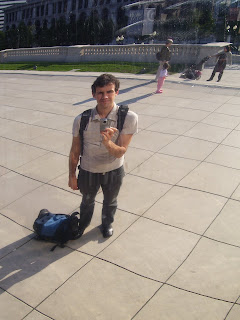
A journal of Zack's experience at JL Zwane Church and Centre in Guguletu, South Africa, summer 2007.

Thursday, July 19, 2007

Football and other activities

Before begin with this post, I want to direct everyone's attention to Tony's blog, listed in my "favorite places to visit". You will learn some interesting little bits about life in Guguletu from more recent posts, but the one from last Friday adds some detail to what I have lately written about funerals here. Check it out.


Since I had the baby's funeral last Friday, it occurred to me that I should get started now with my write-up for Princeton Seminary. I had my "significant incident" ready to go, and a slow week after a busy one ended on Monday, so I have gotten started with the write-up. I will try to finish it next week, then make changes and additions as appropriate my final week here. I always intend to get my academic work, papers, etc. started early, but it often doesn't work out that way because students are so busy at Princeton. Might as well take advantage of the sometimes slow pace here to be on the ball. Doing the write-up has involved describing my weekly activities, so I thought I would pass some of that info on, FYI.


This past Monday I taught training session for volunteers which Yvonne has assembled to get involved in the ministry. I was asked to do it last week on a bit of short notice. Then I had twelve hours to prepare a funeral service for a six-month-old, and suddenly having just a few days to prepare a training didn't seem so bad. The session was on "Understanding Call to Service and Ministry", the topic Yvonne had chosen for me. It ended up going pretty well. I had planned a two hour session, but the person who was meant to do the second two hours never showed up. That ended up being okay, because the activities I had planned for the group ended up taking much longer than I thought they would. I filled the whole four hours session, went overtime, and still had things left undone that I had meant to cover. I spoke for a while to introduce the topic, and with questions that ended up taking nearly an hour. I asked other staff to share their calling stories, which also filled up an hour, although I had only figured on 30 minutes for both. I could tell it was time for a tea break, then I had everyone divide into groups of three to read and answer questions on a Bible passage I had printed out for them. The Bible might not have been my focus had I been asked to do something like this in the States, but given my lack of materials here, and the fact that I thought the people here would relate very well to biblical stories, I made that my area of focus.


I chose passages describing the "call" stories of notables from the Bible, the common element being that they all were ordinary people, who didn't seem cut out for leadership. They lacked confidence in themselves (Moses) or in God (Gideon), were real schmucks (Jacob, Paul), were too old/young (Abraham, Samuel, David, Jeremiah), or were lacking in what we might call the appropriate qualifications (Jesus' disciples). In my experience working with church volunteers in the past, I often found that they wanted to help, but felt like they could never speak to groups, lead, etc. From what Yvonne and others here had told me, church volunteers in Guguletu deal with the same confidence issues. I think the trainees related to the material very well, and I had no trouble speaking extemporaneously, with very occasional reference to my outline. I was dealing with confidence issues myself, since it has been a long time since I was involved in teaching or leadership of any kind, but it all turned out well. I preach in less than two weeks, so the events of the past week have been good confidence boosters for me. I plan to discuss my chosen passage (all or part of James ch. 2) with a few people from the congregation so that I can better understand how the Bible is interpreted in this setting. That Cultural Hermeneutics class I took last semester is going to pay off.

Aside from attending/conducting funerals, my acitivities week to week have involved the following: pastoral care visits (elderly, HIV/AIDS sufferers, orphans, hospice patients); attempting to get some admin work to do (compiling a database on orphans we serve, planning, training, recruiting volunteers), although it has been slim; meeting with partners and other visitors from the States and South Africa, learning about how they have gotten involved with JL Zwane and formed funding relationships (and in one case having dinner and bar-hopping with some members of a church choir from Philadelphia).


Social life has been a bit tough, although I have been out with people my age from church on a few occasions, and made friends with older co-workers as well. Crawford Brubaker, a fellow PTSer is in Cape Town for the summer as well, and we have hung out a few times. Last night I went to "90 Minutes for Mandela", a football (as in soccer) game pitting an all-Africa team vs. a team of players from the rest of the world in honor of Mandiba's 89th
birthday. Mandela is at left holding the FIFA World Cup after it was announced that South Africa would host in 2010. Anyone want to come back with me? The players on the Africa XI and Rest of the World XI were mostly retired former greats (including Pelé, aside from David Beckham the only soccer player famous enough that most Americans have heard of him, although I don't know if he got his 66 year old feet out on the field) and you could tell their old legs were pretty stiff. Some of them still had it, however, and there were some world class younger players, like Samuel Eto'o, the Cameroonian Barcelona star. The match was at Newlands Rugby Stadium, and getting in was a bit scary because people seemed ready to stampede. That didn't happen, fortunately, nor was my pocket picked in the surging crowd. It was a fun event, and a good chance to make friends with a group people I met last weekend. Also the first time I have seen a soccer game since college. The professional leagues here start their season just before I leave, so I will try to get to a game at Athlone Stadium, across the street from where I live. Tomorrow is my day off, and I need it! I will report back Sunday or Monday.

Wednesday, July 18, 2007

More funerals

So, like I have said before, funerals are a much more common part of life here than in the States. I have been to nearly as many funerals in the past six weeks as in my entire life up to this point. Mkhululi's funeral was last Saturday, and he also had a memorial service the previous Wednesday. I think this came about because his family attends another church, where the funeral was probably meant to be held, so there was a desire to have a service at JL Zwane for Siyaya and all of the people who cared about him here.


Both services were long, in large part I think because they were conducted by people from Mkhululi's church, which is quite charismatic. Strangely, the Spirit seems to move people to stretch things out, rather than to do them succinctly. Both services had a lot of music, singing, and dancing, and they were actually pretty fun. I think Mkhululi would have wanted it this way. Siyaya members past and present performed, and it was a good time. The picture at right is from a performance Siyaya gave for a group visiting from the States the week before Mkhululi was killed. They came out in these costumes at one point during the memorial service. The guy in the middle is an amazing tenor. During the memorial service, the sanctuary was about half full at the beginning, and overflowing by the end. This is how it usually goes here. Although people's sense of punctuality is different here, some things are not so different from the States. Babies cry. Cellophane-wrapped candies are opened noisily. People's cell phones go off in the service. One woman (who had been talking the whole time with her friend) actually answered her phone and carried on a conversation! I was not the only person glaring back at her, and I don't think her rudeness was at all indicative of the norms here. There was one speaker after another, which is appropriate, but hard to sit through for three hours of in a language you don't know. I confess that I often flip through Greek vocabulary flash cards during services. When Mkhululi's minister spoke at the memorial service it was nearing seven, having started at four. The only bit that was in English was the oft-repeated "I won't speak to you for very long." Thirty minutes later, Yvonne came up and whispered in his ear, presumably saying "We need to lock up."


On Saturday, I came to church again for the funeral, having conducted one the previous day which I posted about a few days ago. It was scheduled to begin at nine. I got there ten minutes early and the place was empty aside from people setting up. Not a soul until 9:25 when, en masse, the coffin and a procession of 80 people shows up, and the service begins five minutes later. That crowd of 80 was close to 400 (however many fit in the church) two hours later. As you can see, this was a much bigger deal than the small family service of about thirty people for the baby the day before. I was asked to sit in the special staff and ministers section behind the pulpit, facing the crowd, so I could observe as the service went on. At noon, people were still coming in late. Needless to say, when 400 people show up it is a much more communal gathering than a funeral in the States would be. I suspect that many people come, ironically, to have a good time with all of the singing and dancing. Mkhululi's mother and some female relatives, as seems to be typical, sat in the front row with a long blanket draped accross four or five laps. His mother wore sunglasses -- the first time I have seen a family member cry at an adult funeral. And Mkululi's mother had been stoic, tough, every time I had seen her previously since his death.


There was a lot of crying at that funeral, but also a lot of ecstatic, rowdy, noisy singing and dancing in the aisles. At one point the members of Siyaya were dancing around the casket singing at the top of their lungs. I could tell that the service was very cathartic for everyone in many ways. I had never seen such a thing at a funeral, even here, which may have been partly due to the charismatic influence. Again there was speaker after speaker. The minister from Mkhululi's church was not there, but he sent two elders in his place. The service was long-long (people often double words in this way for emphasis). Mkhululi grew up in Bloemfontein, which is a heavily Sotho region, and he was initiated (circumcised and the whole ceremony, which will make another post) in the Sotho tradition even though he and his family are Xhosas. At one point near the end, young men in Sotho dress came out and sang tribal songs around the casket, which was very powerful to watch. The Sotho wear big blankets tied around their shoulders and over their clothes, which is actually not a very old tradition, dating back to the mid 19th century when blankets were one of the main goods provided by British missionaries to the region and became fashionable among the people. At any rate, singing and dancing, these guys then led the procession to the cememtery. On foot. While the rest of us followed in cars, buses, and taxis. The cememtery is less than a mile away, but you can imagine how long that trip took.


I had not been to the Guguletu cememtery on a Saturday before. It was packed. There were dozens of burials gong on, and maybe two thousand people around the cememtery. The burual took a while, as one of the elders preached a half hour sermon at the grave side. This made me very impatient, as I feel pretty strongly that verbosity is not helpful for people who are grieving. Even if you are saying something good, they don't have ears to hear at that moment. But finally Mkululi's casket was lowered, and the elders and then the family members each cast their handful of dirt and a flower. Then the most moving thing I've seen at a funeral happened. It was time to bury the casket, but rather than having the gravediggers do it, Khululi's friends and male relatives took up shovels and took turns filling in the grave, casing a few shovelfulls, and passing the shovel on to the next man. There was some rubish, stones, the sole of an old shoe, plastic bags, mixed in with the dry soil as they buried Mkhululi. That made me sad. The cemetery is quickly filling up, and there is not the time for beautification. A herd of goats was grazing around us.


We then went to the house, waited for the family to arrive and wash their hands first, then sat at the umfundisi table to eat, while most people ate from styrofoam trays outside. It was quite a feast, which is standard. Most people are unable to afford such expenses, and feeding hundreds of people after the funeral, but join burial societies like the ancient Greeks and Romans did. I posted more about funerals previously, if you want more detail. At the table I sat next to the elder who had preached too long at the graveside, and he had a very interesting story about how the apartheid government forcibly relocated him and his family to Guguletu in the 1960s. They had been living in Simon's Town, where the penguin colony is, but such desirable locations were deemed "whites only". Again a sign that there is more to a person than my first impression. It was a long day, but something I needed and wanted to attend. It probably will not be the last funeral I go to while I am here.

Tuesday, July 17, 2007

Contact info

If anyone wants to send me a postcard, baked goods, cash, etc. this is the address:

Lutheran Youth Centre
P.O. Box 421
Athlone 7760
Cape Town
South Africa

It takes a little over a week for mail to get to the States from here. Hopefully it doesn't take too much longer coming the other way.

Sunday, July 15, 2007

uZack, umfundisi

People at church have started calling me "umfundisi" (pastor), a term of respect that I don't feel like I have earned. I got started on Friday. Late Thursday afternoon as I was finishing up a presentation for Monday, and was in the office a bit later than usual, Zethu (wife of the pastor) came in and told me that a baby in the congregation had died that morning, and someone was needed to preside over the funeral the following morning. Because Spiwo and Edwin (the two ordained people on staff) are both out of the country, and ministers from other local churches would be unavailable, I was looking like the only person who could do it. I could have said No, and I thought about it for a second (it was very short notice after all!). Then I realized that I have worked with parents grieving dead babies before, and that the Presbyterian Book of Common Worship would have prepared options for a funeral service. Yet another way that my chaplaincy experience last summer has come in handy here in Guguletu. That night I read through the service in the BCW, chose some scriptures, and wrote down a brief order for the service.


I arrived the next morning at the house accompanied by two colleagues. Within a few minutes of my arrival it was clear that the family already had worked out what they wanted to do, and the child's uncle was an elder in his own church with a ready game plan of his own. In a way this was a relief, because working cross-culturally I didn't want the family to be too dependent on me, a foreigner and a white man, to conduct the service. I asked some questions, got the child's name (Chulumanco, which of course had to be something difficult with two "Cs", one of the click sounds in Xhosa), and and learned that he had Down's Syndrome and a chest ailment, which had eventually killed him. Just when I was going to begin what I had prepared, everyone started singing, which I was glad to see. Singing is essential to any service in this community and I wanted to make sure that they had ample opportunity, although I was worried about how to go about asking them to sing at the appropriate "Hymn" moments in the service. I should have known better by now. During worship people here seem to break into song spontaneously, in the middle of a sermon or any other place in the service. I can tell there is some logic for when they do this, but I haven't been able to figure it out. It was yet another sign that I wasn't really in charge, which threw me off, but also took the pressure off of me. I remained standing, and when they had finished singing I read the opening verse of the service. As soon as it was out of my mouth, however, the uncle came to my side and said "It's time to bring in the casket now." So everyone rises and begins to sing again, from memory, in several-part a cappella harmony, while a man carries the tiny casket in under his arm, which was so striking it was almost comical. I wished internally that two people had carried the casket together, just so it wouldn't be so shocking.


I continued to stand around, feeling a little bit awkward since I was not really running things and had to wait for their cue to proceed. Another thing chaplaincy taught me was flexibility, not being a control freak, but allowing things to happen naturally while guiding them as appropriate. I read a prayer, asked the uncle read a passage from scripture in Xhosa, and was ready to move on when there was a mass exodus into the back room where I had met the mother upon my arrival, and where she and some female relatives had remained. The uncle said, "Be patient. Just have a seat." This gave me the opportunity to think again about what I was going to say in my little homily whenever they came out. I knew they would be expecting some kind of sermon, which was probably the whole reason I was there. They know how to do their own service, but an umfundisi is needed to give the sermon, to put the official stamp on the proceedings, as it were. I do not regard preaching as any more respectable or more important than other pastoral duties, and I get frustrated with ministers who are all about the sermon and crap at pastoral care. I wasn't there to preach a fire-brand sermon. I was not out to "bring it", Princeton friends. The service isn't about me saying a good word or impressing anyone with my eloquence or brilliant exposition. This sermon would be a means of giving pastoral care.


As I sat there I could hear people weeping and wailing in the back room, and someone praying fiercely in Xhosa. I couldn't understand the words, but you could tell it was a "Why, Lord?" prayer, asking God for an explanation, or at least some help, in a moment of despair at the absurdity of six-month-old's death. As I am sitting there I am learning and refining what I will say. I dealt with some dead babies at the hospital last summer, mostly still-borns, but there was one very memorable time where I was there from the frantic arrival in the neo-natal intensive care unit to the baby's eventual death. I had been left holding a dead baby for so long that I began to feel really odd. So I could handle seeing a closed, tiny casket. But the shock and senselessness of a child's death is the overwhelming feeling a family has at such a time. Babies aren't supposed to die. When an adult dies, you can recount her accomplishments, her characteristics, stories, relationships, etc. There is not much to say about a baby's life. What is tragic is the knowledge that a child never had the chance to make stories, touch people's lives, succeed in his endeavors, or even really develop a personality like the child at right. For this reason, the funeral on Friday was a much simpler affair than the huge events that adult funerals are here in the townships. Mkhululi's funeral was Saturday, and he also had a memorial service last Wednesday, and when I post about those events you can compare them to the baby's funeral. They don't make too big of a deal out of children's funerals here because there is not much to celebrate. But as I was witnessing in the ten minutes of sitting quietly, hands folded, while people were praying in the mother's room, the lack of accomplishments by the child does not equate with a lack of grief for the family.


By the time they came out, and I resumed my little service outline, I had some good things to supplement the sermon outline in my head. I focused on the things I said to the mothers of dead babies in the hospital: acknowledging the incomprehension, the anger, the questioning, the despair that people feel in that situation. I affirmed them in feeling those things, and said that there were no answers for why this happened. Faith does not answer our questions most of the time, it doesn't tell us why they happened, but it can help us to survive them. God can handle us feeling angry with God, and I don't think it is helpful to stuff our questions and frustrations. If God is for real, God can work with those things that we authentically experience. God isn't sitting up in heaven judging us for being mad. The only God I care to believe in is one who is mature, a big kid, with the grace to handle our anger. If we believe Jesus was God, then his story too speaks powerfully to God's presence in our suffering, feeling every pain that we experience in our lives. God is not aloof, I told them. God is here, and will be here. That is the only answer, the only explanation that can be uttered in a moment of despair. It's not always an answer that I have the faith to give, but there isn't another one. I only spoke for about seven minutes. I believe verbose ministers should not conduct funerals. Besides, I didn't want to drag on, and I didn't want to make myself the center of attention.


So I said my piece, they sang some more, I gave people space to pray out loud, and basically tried to recede into the background as much as possible so as not to get in the way of the different things they wanted to do with the time. When eyes turned to me to resume I went through the steps, prayed the Lord's Prayer, gave a blessing, and... They weren't done. I had to just sit down awkwardly to let them know I was spent. The uncle finished things up in Xhosa, and I waited. Then it was time to go to the cemetery for the burial, which I was not expecting I'd have to do, but there was a format in the Book of Common Worship for the committal. The cemetery was empty, since most funerals are on Saturday. I tried to figure out what was appropriate for me to do in that situation, what was the cultural norm, and asked the uncle if I wasn't sure. Oh yes, they should lower the coffin now, shouldn't they. Do I put the first handful of dirt on the coffin, or the family? I said what needed to be said, and did it quick. No need to linger, or preach another sermon as ministers at funerals here are prone to do. Ashes to ashes. Dust to dust. Between the size of the grave and the sandy texture of the soil, it took about three minutes to fill the grave in. Then I went back to the house for the meal, and while others ate outside I sat at the umfundisi table, like I always do. I like to think it's because people know who I am, or at least know the people I'm with. I always hope it isn't just assumed because I am white. In any case, my rightful place was at that table this time. I felt I had done something to be there. I hope my words helped the family to have closure and move on, but I think the best ministry was done by themselves for one another. Like I said, I was just there to make it official.

Monday, July 9, 2007

Generosity of spirit


The HIV/AIDS support group is one of the main ministries at JL Zwane, and the church was one of the first in South Africa to really deal with the issue head on. There is increasingly greater acceptance of people living with HIV in South African churches, although it has been a hard road. Spiwo was telling me today that when he announced the church's vision to work with HIV/AIDS fifteen years ago there were many people in the congregation who resisted, and even left the church. Many of those had a change of heart later on when children, spouses, and other loved ones died of the disease after living in shame and silence. Now the support group is a thriving program, with a nutritional aspect done in partnership with Spar, one of the main South African grocery chains. Support group members have a hot meal every weekday afternoon, prepared for them by Mama Katoni and Nqo; and 50-100 people show up for the support group meeting every Tuesday.


As I have mentioned in previous posts, there is a message from someone living with the disease at every church service. I think this is a very important theological ingredient in the worship life of this or any congregation because it reminds us that church is not removed from our daily lives, which are revealed as sacramental by breaking down the walls that separate church from the community. Spiwo was telling me today that a partner church in Pensacola, Florida was inspired by this element in the JL Zwane service. When their community was hit by a hurricane a few years ago, this Florida church began to incorporate a message from people in the congregation suffering from the damage and struggling to rebuild their lives. Others in the congregation often had no idea what their neighbors were dealing with, and this addition to the worship service created a greater sense of community and responsibility for one another in the congregation. I really resonate with this notion of connecting theology and the sacramental life of the church with practical issues and the struggles of everyday life. Spiwo puts a strong emphasis on this, and it is from this perspective that the gospel is read and interpreted here in Guguletu.


Theology needs to be relevant to people's daily lives because God is relevant to, and present in, daily life. The task of theology is to continually connect it to practical issues, and theology must be informed by praxis. I am pretty pragmatic in this regard. There is certainly a place for abstraction, but it should never be primary because God is ultimately found in human communities, not apart from them. Theology needs to matter for everyday life, it should involve getting our hands dirty. The realities of our circumstances affect the way we do theology anyway, so it is best to be conscious of this process and thoughtful about it. Besides, theology that has no connection with the life of a community and the individuals in it will struggle for relevance in that context.


The HIV/AIDS support group is an excellent example of how this works out in Guguletu. A big reason the church (and not just in South Africa) has so often shunned and excluded people with HIV/AIDS is because of the moral stigma that is attached to the disease. Spiwo encounters a lot of ministers who regard AIDS as divine punishment for homosexuals, adulterers, promiscuous people, prostitutes, drug addicts, etc. The assumption is that anything that happens to a person in her life is a reflection of God's reward or punishment. This is the theology of Job's friends, a commitment which allows such ministers only one response to people suffering from the disease: condemnation and rejection. Spiwo's attitude on the other hand is that if AIDS is God's punishment for sin, then we all ought to have it.


Besides, the equation breaks down when you realize that the majority of South Africans with AIDS are women, many of whom have the disease because of the secret laisons of their husbands. South Africa also has the world's highest incidence of reported rape, the victims of which are frequently young girls. Partly, however, HIV is spread because of cultural sexual mores that are very difficult to change. Spiwo said recently that he began working at the church in 1989 he has presided over fewer than thirty marriages. But he has baptized over a thousand children. We cannot make this reality go away by ignoring it, and condemnation doesn't do much either. Being in the shame business doesn't help the church to confront the pertinent issues a community faces. The communal shame that often comes with being diagnosed with HIV is a primary reason people avoid getting tested, giving the disease ample opportunity to spread. But when a church welcomes and affirms the human dignity of people with AIDS, even telling them they are beloved children of God, and works to support them through education, counseling, and friendship the barrier between the church and the world is, in this one area, broken down.


Who would Jesus minister to, after all? The righteous (whoever they are)? No. He hung out with the outcast and the despised, the unclean, the sinners. It has been said so many times that it is a cliche by now. But think about how radical Jesus actions would be even today! Read the gospels, and you will find that Jesus never mentions someone's sin unless he has already shown them love. The only targets of his unequivocal condemnation are the self-righteous religious authorities. To which group do preachers who condemn the sin of HIV-positive men and women belong?


Grace actually enables us to love one another. If love is always heavily conditioned before we give it, we transform it from gift to transaction. "Do x, don't do y, and I will love you. You have to keep your end of the bargain. I'm not just going to give this love stuff out for free, you know. I won't be taken advantage of!" There was a time when in the English language love and charity (which comes from the Latin caritas, which includes the sense of grace, or gift) were used fairly interchangeably. Read the hymn to love in 1 Corinthians 13 in the old King James version, and you will find it is all about "charity". Indeed, charity meant agape, something like "generosity of spirit" (to borrow the BGlass motto), rather than the much more restricted meaning it has today. This is the spirit I see with the support group. They really love each other. Pictured here are two members of the support group whom I visited with other members a couple weeks ago. The two are currently homebound, but having the support of others in the group reminds them that they are not alone. The younger woman in the top picture is named Portia, great Shakespearian name. You can see by the second woman pictured that HIV/AIDS is not only an issue for the young. I should mention that I never show a picture or give a name for someone who isn't public with their status. I have had some very moving visits to people suffering from AIDS, but I'll save them for another post.

Friday, July 6, 2007

Table Mountain


Since I have had some heavy posts lately, it is time for something a bit lighter. By the way, comments on the blog are open to anyone for a good reason: if you are ever bothered, offended, pissed off, or otherwise violently disagree with something I post, leave a comment. Even a nasty one! Or a lovingly correcting one. Something Spiwo has said to me several times is that, as a foreigner and visitor, I will receive a lot of grace for making stupid comments. He finds this to be true when he visits the States, and he will sometimes ask very obvious or delicate questions simply because he knows he can get away with it. So, if I post something foolish, ignorant, or just plain wrong, you are invited to let me know what you think!


That being said, this post is sure to challenge the delicate sensibilities of no one. Cape Town is in a beautiful location, sandwiched between the sea and a huge, gorgeous mountain, which is visible from all around on a clear day. The "tablecloth" of cloud frequently covers the mountain, and in fact I was here for a week before I could even see it. There is a cable car to the top, but if you're reasonably fit you can also hike it. The unpredictable weather around the mountain makes the hike a bit dangerous if you are foolhardy (one or two tourists die every year on the mountain), since cloud and impenetrable mist can drift in suddenly, so that you are forced to sit tight and wait it out. Or go down blind and risk tumbling down the mountainside, or over a cliff. However, on a clear day like the one I went there is nothing to worry about. I took the cable car to the top last weekend (perfectly, breath-takingly clear) and had a look round. From the top you can see out to Cape Point, Robben Island (where Nelson Mandela spent 18 of his 28 years imprisoned by the Apartheid government), and the whole city of Cape Town unfolding below you. The city itself is pretty tiny, more or less walkable end to end, although with the suburbs and the Cape Flats thrown in there are about 3 million people here. The only place you couldn't see is Athlone, where I live, and Guguletu, because Devil's Peak is in the way.


Devil's Peak has a great story. There is a legend that an old Dutch pirate named Van Hunks, while climbing the mountain, encountered the Devil, who challenged him to a smoking match -- for his soul. The mists which often cloud Devil's Peak and the other mountains are the results of the ongoing contest. All of the hills and mountains in the range have great names, by the way: Table Mountain, Devil's Peak, Lion's Head, Signal Hill, and (my favorite) the Twelve Apostles.


After checking out the view from the top of Table Mountain, I took the hike back down, which again was stunning. Here are a few shots. 1) A photoI found online which shows Cape Town and the harbor with Table Mountain in the background. 2) This one is taken from the stairwell in the building where I live, which is to the east of the mountain and Cape Town. 3) Robben Island, South Africa's Alcatraz for political prisoners. Now a museum and UNESCO World Heritage site. I will go in August when they are done with restorations on Mandela's cell. 4) Me at the top, camera facing to the south. If I weren't in the way you could see Cape Point. 5) Cape Town from the top of Table Mountain. 6) In the ravine that led downhill. Amazing natural beauty. I had a big smile on my face the whole way down. I would have made it down faster if I weren't stopping to soak in the view so often. This was the last photo I took before my camera stopped working. It's now in the shop.


Thursday, July 5, 2007

Uncomfortable issues


Yesterday I had a conversation with Spiwo on a topic that made me a bit uncomfortable, although it was important for me to know to develop a clearer assessment of the nature of poverty in South Africa. Spiwo had been in contact with a young man who is an aspiring volunteer, but who has a bad reputation around the community for being a loafer. There is a huge unemployment problem in the townships, in large part because people keep coming in from rural areas faster than housing can be built or jobs created. There is a need for 650,000 housing units in the Cape Flats alone. The government is currently building at a rate of 8,000 per annum in the whole country! Unemployment is a huge problem, but even so there are able-bodied young people who don't hold down a job even if given the chance. This lack of work ethic, Spiwo said, is a big problem everywhere.
Now I am a good liberal, not ashamed of my bleeding heart, and this touches a nerve because I have so often heard the argument in the States that "the poor are just lazy", which excuses the securely-employed and affluent from feeling any responsibility for the state poor people are in. Besides, I have met a lot of poor people who work very hard, and seen how their disempowerment by past and current political, social, and economic systems has so much to do with their failure. This notion of the lazy poor is a typical white stereotype in the States, and you can see it lurking implicitly beneath many arguments against welfare and other social programs. If you dig a little deeper, I think you will usually find that these "lazy poor" are also imagined to be people of color. So, to hear by black supervisor making an argument reminiscent of these stereotypes doesn't sit well with me at first.


So I ask Spiwo where this lack of work ethic comes from, especially what role the legacy of Apartheid may have played. It is not the whole story, Spiwo thinks, but Apartheid bears a great deal of the blame, since black South Africans have been exploited as cheap labor for over a century, and they have not been compensated for the back-breaking work that built the country's economy (especially in the mines, which remain the backbone of South Africa's economy). White owners always made the argument that paying the black workers more would kill the industry, and with it the economy. Yet the marginal revenue of the mines seems to have exceeded the marginal cost enough to make the owners very,very rich. Other examples abound. Combined with Bantu education that made sure blacks were unskilled and the purposeful unavailability of anything but dead-end jobs, it is understandable that people would conclude, after a certain point, that the system is set up to ensure their failure so they might as well not try too hard.


Spiwo was quick to point out that there are a lot of people in the townships who are very motivated, who find ways to acquire some of the skills the education system has failed to provide them, who find a way to get capital and start a business, etc. Spiwo is always saying there is so much talent and ability in the townships, but for the most part it hasn't been unlocked. People who have been disempowered by an oppressive system, like their parents and grandparents before them, can become mentally and spiritually disempowered. Not only are they excluded by lack of opportunity, but they learn not to believe in themselves. People who find a way out of such a situation are pretty extraordinary. They are like the middle-class kids who get into Yale, who achieve higher than peers who had the same opportunities, and go to a prestigious institution despite lacking the benefits of connections, legacy, great wealth. They are exceptional, and we should not reason that because a few succeed in this way that everyone in their situation should be able to do so as well. They may be more meritorious than the people who have the opportunities handed to them.


To use examples from US politics, both the current President and his rival in the last election went to Yale. Both were legacies, and both got mediocre grades while they were there. Yet both of them later got into Masters programs at Ivy League institutions. Was it because they were the most qualified and capable, or because they were connected? If I had gotten a C- average as an undergrad, I would not expect to hold national office later in life. Now, obviously both of these guys got their act together to some degree at a later point, but they had a safety net that others do not.
One of the most cherished assumptions in the United States is that we live in a meritocracy, yet merit requires opportunity to be realized, and many brilliant people never discover their ability because they have no one to help them see it and believe in themselves. A lot of poor people work very hard just to keep their heads above water. There is no denying that there are lazy poor people, any more than there are lazy rich people. What do year-round snowboarders living off a trust fund or Paris Hilton contribute to society? I grant that there was some level of opportunistic skill in Hilton's ability to use an amateur porn video to make her a true celebrity, i.e. someone who is famous just for being famous, but what has she ever done for anyone else? Not a very feminist example, I know, but she is not such a good example of feminism. I digress. The only difference between someone like Paris Hilton and an unmotivated poor person is that Paris has rich parents to leach off of, and doesn't have to experience consequences for any lack of work ethic. Meritocracy is a myth, and I mean that in the deeper sense of a cherished, almost metaphysical belief that founds the way a culture interprets reality. We don't talk about the Protestant work ethic for no reason. But it is also a myth in the more typical sense. Those who work hard do not always benefit, and those who reap the rewards are not always the hardest working or most creative. Opportunity and connections are the key to unlock the potential of skills and creativity. Americans believe in equality of opportunity, but we don't seem to believe in seriously making it happen.


So bringing things back to South Africa and my conversation with Spiwo (aka Dr. Xapile, aka umfundisi, aka my supervisor, in case anyone was confused), what is the response to the mentality that keeps people stuck just as much as the system does? For him personally, in his ministry, it is to encourage people to use their gifts and talents to contribute to the good of others in the community. He has worked to do this by forming a leadership team, with representatives from each of the eighteen "zones" the area around the congregation has been divided into. These zones are responsible for staying abreast of what is going on with people in the zone, who is sick, who has died, who has contracted HIV, who is hungry, etc. It is a gradual process to create a system where people take ownership of their community, take responsibility for thinking of ways to meet people's needs and maintain relationships, and a where there is accountability. It doesn't work perfectly, but there is a vision in place for how empower a core group of leaders, and to begin to empower the community through them. The ultimate goal of any social program (whether governmental, non-profit, or church based) should be to help people see the talents they have and give them opportunities to develop those talents and use them for the benefit of themselves and society. Spiwo said something I thought was very interesting in connection to this, "I find that people typically respond very positively to being trusted with responsibility. Especially here where many people have never been trusted. It can really change a person and the way she sees herself." There are huge limits on what JL Zwane can do, but Spiwo and the other staff are working to expand the ministry.


This is only a partial solution to an overwhelming problem, which obviously is a lot more complex than what I have portrayed above. I was reading a couple of articles about affirmative action programs here in South Africa, which are a facet of Black Economic Empowerment (BEE) programs in the country, but I think I will save those for another post. As in the States, there are no easy solutions to problems of poverty and racism, and there is not such consensus about how to address them. I am including a couple of pictures of the township and the lighthouse in Cape Town. Since my camera stopped working I have to rely on the pictures that are already on the memory card until the camera gets fixed.

Tuesday, July 3, 2007

Worse news

This morning as I was getting ready for work, Tony called and said the staff would be doing a prayer service for Mkhululi this morning and wanted to make sure I would be there. Since umfundisi and Edwin, who is also ordained, are both out of town, leaving me the only half-way pastorally trained person present, I was asked to lead the group in a prayer.


As Tony informed everyone of why we were gathered, he said that Mkhululi had died of his injuries late last night. I had no idea, but I then had to pray seconds after the news had been broken to me. My chaplaincy experience has given me good practice at praying on the spot, and especially at knowing how important it is to acknowledge the shock of moments like this, the fact that there is no way to make sense of it. Now, I was feeling that shock, that incomprehension, myself. This is the time to call out to God in mourning, in disbelief -- not the time for comfy theological answers. Afterwards I went to Mkhululi's house, saw his mother and family, and the members of Siyaya who were all gathered there, huddled together in complete silence. I did not break the silence. There are no words to say at that moment.


I was pretty shaken up by seeing Mkhululi yesterday, and I shed a few tears thinking about him last night. And now he is dead. It is a memento mori, a reminder that death comes to us all, even when we are young and invincible. We are so fragile. It puts small challenges that have caused me stress over the past week into perspective. Calling cards didn't work, I got stuck in traffic, I got cut off and cussed out, I got lost in the townships, I lost my phone, I got robbed by two kids (who took my new phone!), my camera stopped working, the console of my car fell off inexplicably, etc. As all these things were happening I told myself, "You can't be defeated by this stuff. They are annoyances. It is a blessing that these problems should be hardest things you are facing."


Umfundisi comes back to town tomorrow, and I'm sure I'll be meeting with him to discuss pastoral care of everyone affected. The funeral will probably not be until weekend after next, giving extended family time to come into Cape Town. Here is the picture of the guys at Mzoli's again. Mkhululi is in the middle in the pink. He wore pink just about everyday. He was very confident, and it seemed nothing could stop him.

Monday, July 2, 2007

Bad news

A terrible thing happened on Saturday morning, which I just learned about yesterday. Mkhululi, one of the guys from Siyaya was hit by a combie (mini-bus taxi) and is in the ICU. He is one of the three guys I went to Mzoli's with last weekend.


I went in to visit him in the hospital today with Bonganyi, the music director, and Johanna. The kid is in very bad shape. I was glad for my experience working in the ICU at the hospital last summer, which prepared me for this a little bit. But I was not working in a trauma ICU, and nearly all of the patients were older people in more advanced stages of disease. Some were hooked up to machines and respirators, just like Mkhululi was. But it is much different to see a healthy young person, especially one you have hung out with in that situation. He had thick bandages on his head, which was very swollen, and the machines were doing all the work for him, violently pounding breaths in and out of his heaving chest, as he is probably in an induced coma. He is only twenty-two, and he is a father. I was glad other members of Siyaya were not there with us.


There is not much you can say in such a situation. There were no family or friends to comfort, and Mkhuli was unconscious, but just seeing someone you know like that is not easy. You ask yourself, why does God allow this? That was always one of the hardest things to address as a hospital chaplain. I didn't have anything profound to say. The only God I could speak about in the hospital was one who is present in human suffering, and does not sit far off and aloof, too pure to get the divine hands dirty. If God doesn't get down in the mess with us, then there is not much use in talking about God. That at least was my feeling. So what is it like when God gets down in the muck with us? That was my question, and I had no answers. Often it was the patients and family members themselves who would be doing the ministry to me in that situation. They had much more business telling me about faith, I thought, than me trying to tell them.


What do I know? I can make the proclamation, "God is here in this tragic moment", but I couldn't point God out. When you sit beside a woman moaning in agony from bone cancer (which has to be about the worst ailment imaginable) theoretical theology is meaningless. She doesn't care, for instance, that Alvin Plantinga has proved that there is no logical inconsistency between belief in a perfectly good God and the reality of human suffering. These abstractions don't matter when you are living in the pain. There is nothing to say, as a pastor, in that situation. Ministry of presence is important -- sometimes it's all you have -- but much of the time it just isn't enough. Hospital visits militate against pat answers and easy solutions. Somehow, that is why I am drawn to situations like that. I don't like easy church answers. I would rather be real about the complexity, the incomprehensibility of suffering. It won't just go away by ignoring it.


A glum posting, I know. But this is life everywhere.

Sunday, July 1, 2007

Township tours with Xolani


Now that the internet is working again, I wanted to post some pictures I took a week ago when I went on Xolani May's township tour. Xolani does these for a living, and often has groups of visitors from out of the country whom he will take along on a half or full day tour of Guguletu, Philipi, and other neighboring townships. There are several companies and individuals who do these tours (a number are listed in my guidebook) although not all of them are township residents like Xolani is. You would never guess to look at him, but Xolani lives in an informal settlement, or just a shack as he is not embarrased to call it. I am giving him huge props for these tours, and it would be great if he could advertise commercially, since much of his business currently comes through connections to JL Zwane.

I really think a township tour like this is the most worthwhile thing someone can do in South Africa. There are lots of sights to see and things to do, but I feel that meeting the people in the country is the most important thing one can do while travelling. Seeing how people in a country live and interacting with them takes one past the simple tourist sight-seeing to actually engage (at least a little bit) with people. Because that's what a place is really about: people. This is particularly true in a country like South Africa which such a history of injustice, inequality, violence, and oppressive poverty. Most people from Europe and the States who come here probably go to Cape Town or one of the other big cities and enjoy the First World amenities and activities, see some wildlife at Kruger, tour the winelands, surf if that's your thing, and go home. All of these things are extremely worthwhile, but they are also an excellent recipe for not having a substantive interaction with non-white people. Now there is not really much to see in the townships for a tourist. You go there for the people, and to see the contrast with neighborhood where your hotel probably is. The fact that the township is not a tourist destination is acatually the best reason to go there, as tourist areas never tell the whole story about a culture. So in my opinion, on a visit to South Africa a township tour is a must.


People who live in Guguletu are proud of it. In fact the name means "our pride". Like other Cape Flats townships, Guguletu was founded in the 1950s when blacks were forcibly removed from Cape Town proper, and other "seasonal labourers" from Eastern Cape also needed housing. Initially, cookie cutter houses were built to house the men who left there families at home to work here and send money back. This was too expensive so eventually the government and the major companies employing these labourers (Coca-Cola, for instance) started building single-sex dormatory-style "hostels", which are still in use today, often with as many as ten people living in a space the size of my dorm room. The amenities in some of the company hostels are much better than in the government ones, although they still tend to be crowded. These housing options were made to be more or less affordable on the extremely low wages the labourers earned. Other, better homes were also built, but these were equalled in number by the shanties that sprang up later on.


There was only one road in and out of Guguletu in those early years, NY1, which is still the heart of the township. All the streets around here are just numbered "Native Yards", although they
have been given proper names since 1994 (which pretty much no one uses, and they aren't labelled anyway). The way in and out of Guguletu was controlled by police, who restricted everyone moving in and out according to their government issued pass. I will write in greater detail about the pass laws later, but essentially they classified each non-white person as either a "native" or "coloured", and police could stop you indiscriminately, and at random whenever they wanted and demand your pass. These laws kept non-whites confined to certain areas, whether townships or the Bantustans (which were instituted around the same time), and millions were locked up for pass "violations" over the nearly fifty years of Apartheid. Massive resistance to the pass laws and demonstrations led to the Sharpeville Massacre in 1960 ( http://en.wikipedia.org/wiki/Sharpeville_Massacre ).


Locally, on 3 March, 1986 government anti-terrorist units (members of the dreaded Vlakplaas) stopped a mini-bus full of students affiliated with the ANC (African National Congress, now the
ruling party) and brutally shot seven of them dead. Television and radio stories that day proclaimed that government units had killed seven "terrorists", and as the Truth and Reconciliation Commission later revealed, weapons were planted on the dead bodies. Governments since the Roman Empire have been using that label for underground resistance fighters. We should be thoughtful about how that term is used by media and by government, and how we are intended to regard people so labelled differently. Those labeled "latrones" by the Romans became eligible for the extreme punisment of crucifixion, and it is often argued today that extreme tactics are necessary to combat terrorists. Back to the Guguletu Seven, pictures at a local mini-museum show smiling soldiers standing over bullet-riddled bodies while neighbours look on from behind the police barricades. There is a memorial there today, part of which is pictured here.


Other highlights included a visit to a Shebeen, an informal tavern in an informal settlement building, which were once illegal, but are sort of okay now. Actually, when we walked in all the men in place became suddenly very quiet. It was not until Xolani explained to them that the white man was not an undercover detective that they lightened up and I got a round of what they were drinking. In this picture I am drinking umqombothi (
http://www.dispatch.co.za/1999/07/31/features/ROMANS1.HTM ), a home-made beer-like concoction made from sorghum and mealie (corn). It looks like soapy water and was a bit thicker than beer. And grainy. It has a sweetish, perfumey taste, and the texture of very thin Cream-of-Wheat. An acquired taste I think, although I hear Anheuser-Busch is marketing a sorghum beer in the US. I very politely drank several big gulps of what I was served, but I wouldn't exactly seek it out again in the future. Back in the day, shebeens were important meeting places for groups resisting the Apartheid regime. We ended the tour with my first trip to Mzoli's, where I ate my fair share of the pile of meat pictured at bottom.


An explanation of the pictures, from the top:

1) Xolani standing beside outhouses in the informal settlements. About a hundred people will use these, and they are only pumped out once a week. Many (but not all) of the informal settlement areas have a communal water tap set up, and as I've said they are often hooked up with pay as you go electricity. I didn't see much of that in this area.

2) Pigs feeding on rubbish. This used to be a nice wetland, but all the garbage has killed the frogs and other wildlife that lived there. No place else to put the trash or dump human waste. It stinks, and is a breeding ground for disease. The shacks closest to the marsh get flooded in heavy rains, and even those farther uphill can have problems with water seeping up from the ground (or through the roof). I have always loved it when it is stormy outside, and I am warm under the blankets drinking a cup of tea. Now, it makes me think of the people in the shantytowns, who have to deal with wet blankets and mattresses, and maybe have nothing but a parrafin heater -- if they are lucky.

3-4) One of the better new houses being built in Langa. It is being remodled from a former hostel building, and those moving in participated in a monthly payment scheme for a while which reserved a unit for them. Unemployment is high, so only those with a steady job and a decent wage could afford to do this. The one we went into had several rooms, lots of light, fresh plaster and paint, very good conditions. You can see by the yard that they are still under construction.

5) Across the street from this new building is one of the old hostels. Pictured are Xolani with the woman who lives in this room with her family, and Sara, an American college student who worked at JL Zwane for a few weeks this summer. One of the crazy things about going around with Xolani is that he will just walk into people's houses, say hi and ask if we can look around.
He doesn't know these people, but they always let us right in. One perk to taking your tour with a township resident.

6) Part of the Guguletu Seven memorial.

7) Me drinking at the Shebeen.

8) Mzoli's meat.